
In the last few months, I have been in a kind of on-hold position with most of my projects. For 2 1/2 years, I have had limitations and pain in my hips. And I’ve been in the process of getting a bilateral hip replacement. Now, it’s supposed to be at the end of June or the beginning of July. But I don’t have an exact date yet.
To support my recovery, I took a two-week vacation in Guadeloupe, aiming to feel rested and well before the operation, which I had initially been told would be at the end of May. Here are some photos— it was lovely.
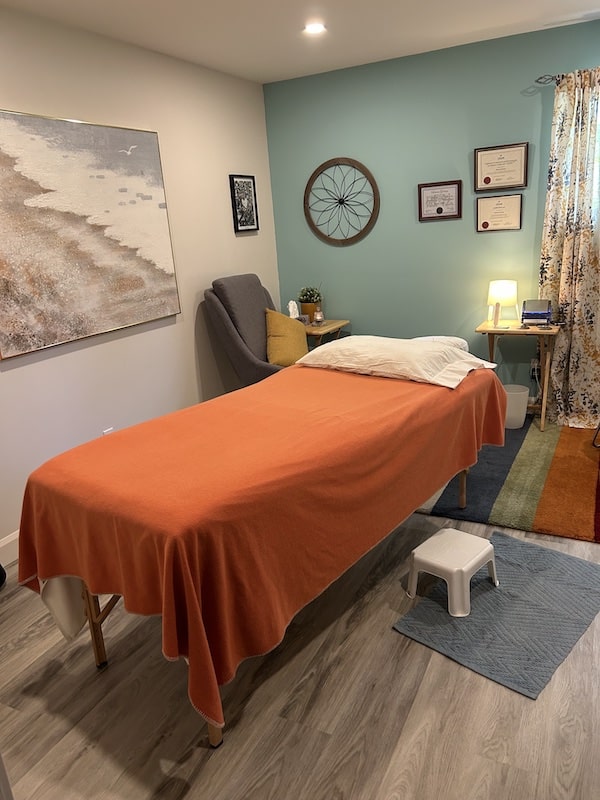
If you would like to schedule a session, massage, or treatment with me in person, please reserve your spot now to ensure availability before my operation.
Pierre B. commented on Google (translated by DeepL)
I have had the privilege of being treated by Sujati on several occasions for chronic back pain, and the experience has been remarkable every time.
Her presence is marked by gentleness, attentiveness, and great kindness.
Every movement is performed with care, sensitivity, and respect.
You can feel a genuine intention to care for both the body and the mind.
A deeply soothing experience that I recommend without hesitation.
Original
(J’ai eu à plusieurs reprises le privilège d’être traité par Sujati pour des douleurs chroniques au dos et l’expérience a été remarquable à chaque expérience.
Une présence empreinte de douceur, d’écoute et d’une grande bienveillance.
Chaque geste est posé avec attention, sensibilité et respect.
On sent une réelle intention de prendre soin, autant du corps que de l’esprit.
Un moment profondément apaisant que je recommande sans hésitation.)
You’ve heard me talking a lot about my Somatic practice work lately. But…
Does Somatic Practice work?
When I first became interested in the somatic-practice work with Kathy Kain, it was clearly a response to my own difficulty with my body and emotions. Realizing that my previous approaches could only take me so far, I asked a therapist friend to do a few somatic sessions with me. This convinced me to seek out a practitioner who was not a friend, and working with her produced a real, beneficial impact on my body and my life. As a result, I was able to leave a stressful relationship and, for the first time in adulthood, found myself single in a healthy way.
Even if being single didn’t last very long…;)
And, it’s not only my own experience. There has been some research into how Somatic Experiencing ( a method closely related to what I am doing) is helping the well-being of people with trauma: From Somatic Experiencing to felt safety: assessing the effects of a body-oriented intervention in adults with various degrees of child maltreatment.
https://pmc.ncbi.nlm.nih.gov/articles/PMC12836407
How does a somatic practice session look?
At first, the sessions looked unrelated to my problems. Nonetheless, they had a huge impact, motivating me to learn the approach myself. And I am in the process of further learning and involving myself in this practice.
Being more embodied—sensing the body and regulating the nervous system—has shown me my dependencies, helped me detach from them, and allowed me to become more autonomous. I don’t claim to be fully healed, but I definitely see a lot of progress.
I believe that most people have some dependency, whether it’s work, alcohol, shopping, cigarettes, drugs, sex, relationships, screen time, or food, to name the most common ones.
This raises the question: What creates this dependency?
A constantly high-alert, poorly regulated nervous system creates immense stress and long-term harm in the body. Negative beliefs that come from trauma prevent the full expression of who we really are.
Often, this stress shows up as a need to fill an emotional void or mask pain that was overwhelming in childhood. Babies, unable to self-regulate their nervous systems, depend on attuned caregivers to calm down their nervous systems when they are upset or hurt. And when babies experience overwhelming events or constant neglect without an attuned adult present, the nervous system (and other systems in the brain) doesn’t develop in a healthy way.
How to know where the trauma is stored in your body?
Depending on what traumatic event you had, you may have different reactions to it.
Common reactions include: Defending yourself, wanting to run away, screaming, disconnecting from your own body, freezing, or holding your body still.
That means the trauma can be stored, for example, in your
– arms, like pushing away, putting the arms up in defence.
– legs, the muscles that have to do with running away, may be tense
– shoulders, they come up to defend from blows
– neck, like a backlash from a car accident
– chest that’s contracting because the heart is hurting from betrayal or abuse.
– belly, that is tense, to not feel the emotions that come up and that are overwhelming.
– or in other organs or physical systems, depending on the trauma.
So, to recap, the places you can store emotions or traumatic events are everywhere.
By working with the nervous system to regulate it, the body will show us where it needs to undo, resolve, and heal things. It’s not necessary to know in advance where trauma is stored. This said, there are often parts of our bodies that have difficulties; that’s a good starting place.
Understanding this, you may want to know:
What to do so that past traumatic events don’t affect you anymore?
Addressing trauma—especially developmental trauma—requires time and patience.
You may have had a deep insight into something very emotional, worked through it, and thought you were done with it. Just to discover another layer years later. Our life is like a spiral. We move on and see the same/similar thing from a different angle. Your system will only bring up things it can heal at this time. Even if that sometimes seems like too much.
By exploring trauma together in small increments—looking, touching on, sensing, and discovering—we enable your whole body-mind to resolve these experiences.
What is developmental trauma?
It is defined differently, and I like this definition: trauma that occurred during the time when the body, nervous system, and brain developed, and which has a negative effect on their development for the person.
Does this resonate with you?
Would you like to try a session at 50% off in Mont-Tremblant (Tuesdays only)? Call or text me to set it up: 514-296-7877