When one has hardship in the family of origin, the holidays could be gruelling! If that’s the case for you, ask for help!
Happy solstice and a joyous time in the holy days
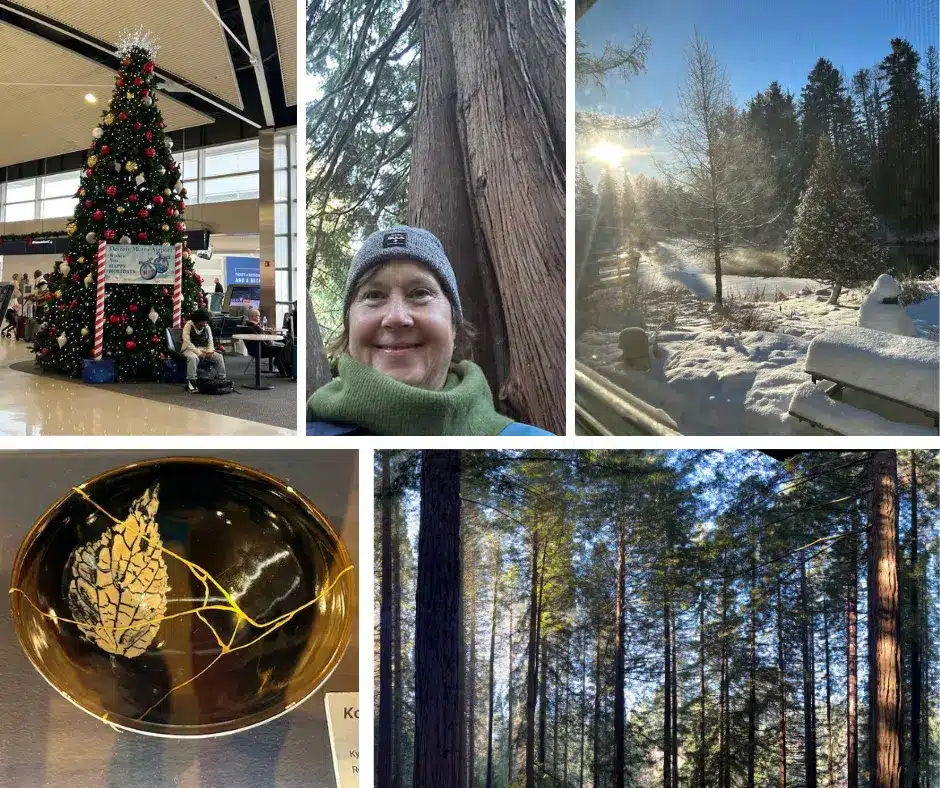
On my way to Portland 2 weeks ago to perfect my “being” with the work with developmental trauma, I saw quite a few Christmas trees. And here in the north in the Laurentian Mountains, winter is gorgeous with the glimmering snow.
I wish you a joyous and restful Christmas season.
May your heart be filled with light and with love.
HolyDays Vacation
I understand that this season can be a difficult time for many. If you need support, I want you to know I’m here for you, even during the Holy Days from December 21st to January 6th. I’m more than willing to make an exception and provide virtual support if you reach out to me. Your well-being is important to me.
Portland, Oregon
I had such a lovely time in Portland, Oregon, at the beginning of December. It was great having two days to settle in and enjoy the luscious greenery, giant trees, and mild climate. I also met a colleague-friend who lives in Portland. We had a great time visiting the Japanese garden with a guided visit, tea ceremony and an exhibition of Kintsugi: The Restorative Art, where broken things are glued together, made more beautiful with gold dust on the glue and through this made stronger than before. What a great metaphor that is!
Resilience and Regulation for Trauma – a Spiritual Practice
After that, in the 3-day workshop on Resilience and Regulation, there was so much value and practice to be even more in this profound work with development trauma. Stephan Terrell and Kathy Kain are extraordinary human beings who have so much knowledge and also so much knowing of how to deal with different clients, symptoms, and difficulties. I was amazed at how similar this healing space is to my spiritual practice. Just being with what is, not wanting or needing it to be any different. To not follow thoughts about what it may mean or go into interpretations about the client. Allowing what is to be there, allowing the space for healing. And that happens only if my thoughts are quiet or when I don’t give any energy to them.
Developmental Trauma
Even though I did my training in also working with shock trauma, like accidents or one-time shocking events, I do notice that developmental trauma is where I’m drawn to. And working with developmental trauma is something that takes time. Safety needs to be established through constant presence, predictability and always the same ways of doing things, like rituals. The practitioner also needs to give the client space to discover themselves and accompany them without judgment or interpretation of whatever the client goes through.
Now, to the question:
What is developmental trauma? How do I know I have it?
Developmental trauma can have many different sources :
- It can be abuse or neglect in childhood, but it also can be hospitalization or an unwanted pregnancy.
- Any separation from the mother when the child is still very young or a baby, or medical interventions that have been traumatizing.
- Also, intergenerational trauma like war, race, gender, natural catastrophes, and so on.
Symptoms of developmental trauma are frequently:
- Hypersensibility,
- low tolerance to stress,
- people pleasing,
- immune system disorders like IBS, HIV,…
- chronic fatigue,
- fibromyalgia,
- feeling like every day is a challenge or fight,
- feeling of not belonging, and more.
Widening the “Window of Tolerance”
What I learned and what we do as practitioners is to work with the autonomous nervous system by widening the window of tolerance. This means we help our clients to expand their capacity to handle stress and discomfort. What does that mean?
Everybody has a certain way where one feels comfortable or somewhat at ease. That translates biologically into the parasympathetic and the sympathetic systems, going hand-in-hand and balancing each other out.
When one or the other is too strong, we are overwhelmed. For example, when the sympathetic is too high, we feel stressed and can’t calm down – which is perfect for fight and flight. The parasympathetic then calms that down once the danger is over. But when the parasympathetic is too high, the person will go into a “freeze” state, like becoming more apatic, not moving much, almost catatonic.
The window of tolerance is where we are at ease, where the two systems balance each other out. Under and over this, it is too much for us. Then, we are out of the window of tolerance.
Through intentional touch into these systems, especially working with the adrenals, which produce adrenaline, noradrenaline, cortisol and other hormones, we learn to ride the waves of up and down and, therefore, widen the window of tolerance.
From my own experience, this makes a massive difference in my life! I can settle more quickly and do things I could not do before. I’m happier most of the time, and when I’m not, I don’t go into the spiral of doom and catastrophe.
My x-mas gift-offer to you
So, if that makes you curious about this work, I am happy to give you a promotional taste with three sessions at a 30% discount! Call, write or text me to get your taste of somatic trauma work with a 30% discount*.
*Available only in January and February 2025.